
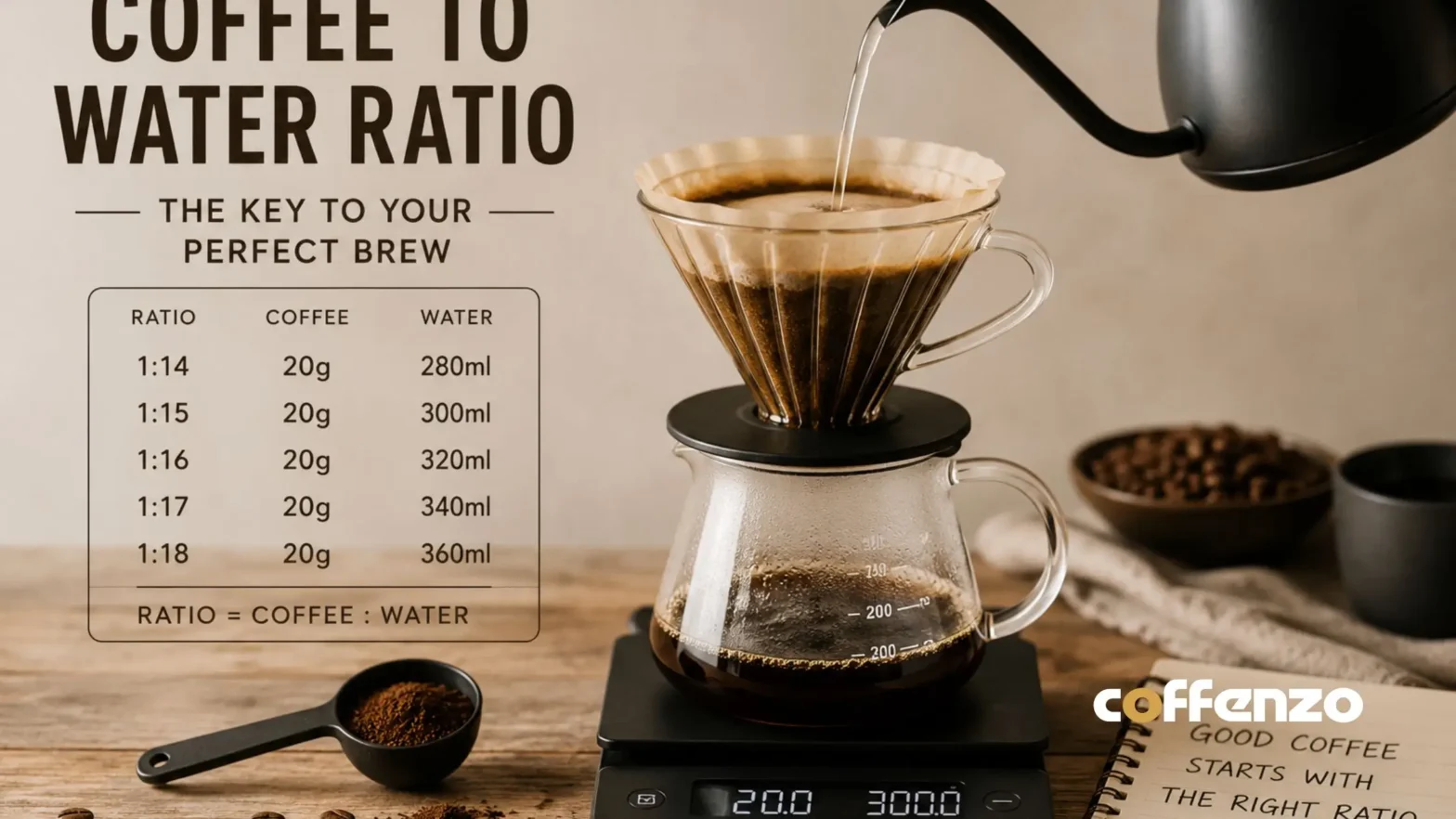
Whether you’re a seasoned home brewer or just starting your coffee journey, one truth holds across every brew method: the coffee to water ratio is the single most important variable you can control.
Get it right, and your cup sings with balance — rich, aromatic, and smooth. Get it wrong, and even the world’s finest beans will taste flat, bitter, or disappointingly weak.
In this guide, we’ll break down exactly what the ideal ratio is, why it matters, and how to apply it no matter what brewing method you prefer.
What is the Coffee to Water Ratio?
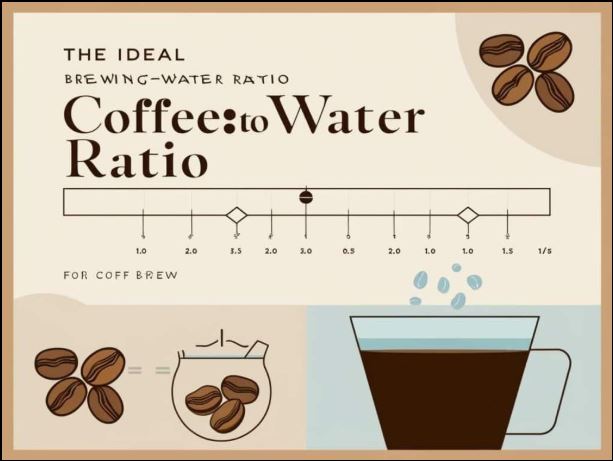
The coffee to water ratio refers to the amount of coffee grounds used relative to the amount of water in your brew. It’s most commonly expressed as a ratio — such as 1:15 or 1:17 — where the first number represents coffee and the second represents water, both measured by weight in grams.
For example, a 1:15 ratio means 1 gram of coffee for every 15 grams of water. A standard 12-ounce mug holds roughly 355 ml of water (about 355 grams), so you’d use approximately 24 grams of coffee — that’s around 3 to 4 tablespoons depending on grind size.
The Specialty Coffee Association (SCA) recommends a golden ratio of 1:18 (about 55 grams of coffee per liter of water) as a general starting point. But this is a guide, not a rule. Personal taste, roast level, and brew method all play a role.
☕ Quick Reference: SCA Golden Ratio = 55g coffee per 1,000ml (1L) of water
How Much Coffee to Water Ratio is Right for You?

When people ask how much coffee to water ratio they should use, the honest answer is: it depends on how you like your coffee. Here’s a breakdown by preference:
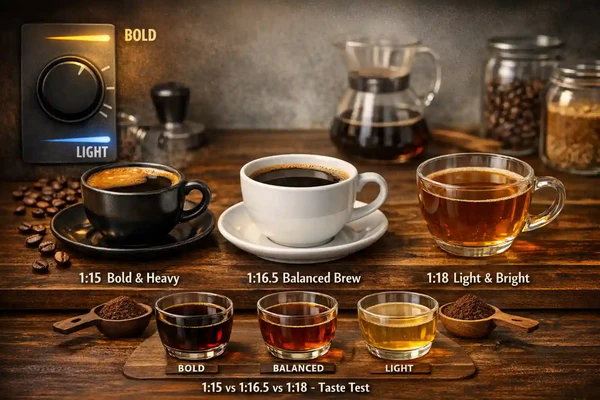
- Strong/Bold: Use a 1:12 to 1:14 ratio. Great for those who enjoy espresso-style intensity or use their coffee as a base for lattes and cappuccinos.
- Balanced/Medium: A 1:15 to 1:17 ratio hits the sweet spot for most drinkers — full-bodied with clear tasting notes and a clean finish.
- Light/Mild: A 1:17 to 1:20 ratio produces a lighter cup that still has character, ideal for those who prefer a gentler brew or are sensitive to caffeine.
The key takeaway? Start in the middle — around 1:16 — and adjust from there based on your palate. Small changes (even half a gram of coffee) can noticeably shift the flavor of your brew.
Compare: How Many Scoops of Coffee Per Cup?
Coffee to Water Ratio by Brew Method
Different brew methods extract coffee differently, so the ideal ratio varies. Here’s a quick reference guide:
| Brew Method | Ratio (Coffee: Water) | Notes |
| Pour Over (V60, Chemex) | 1:15 – 1:17 | Clean, bright, highlights origin flavors |
| French Press | 1:12 – 1:15 | Full-bodied, rich, heavier mouthfeel |
| Drip Coffee Maker | 1:16 – 1:18 | Everyday standard; easy to replicate |
| AeroPress | 1:6 – 1:16 | Flexible; adjust for espresso-style or Americano |
| Cold Brew | 1:5 – 1:8 | Concentrate; dilute before serving |
| Moka Pot | 1:7 – 1:10 | Espresso-adjacent; bold and intense |
Why Weight Beats Volume Every Time
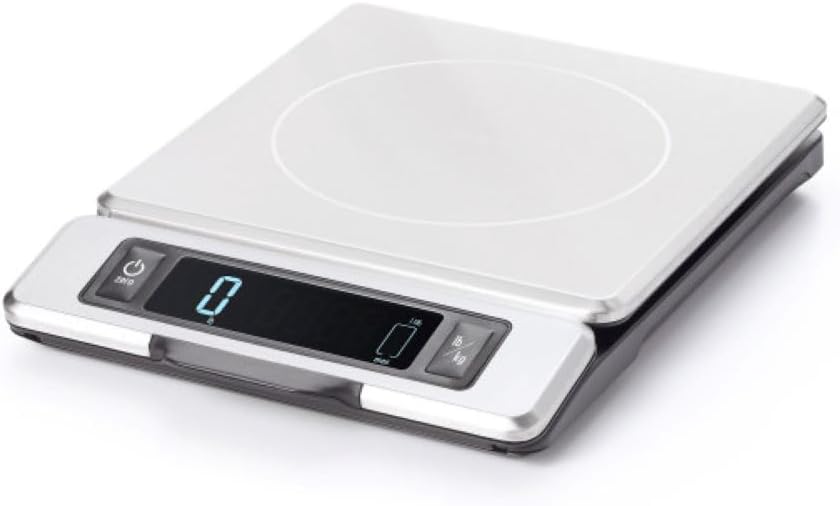

One of the most common mistakes home brewers make is measuring coffee by volume — using tablespoons or scoops — rather than by weight. The problem is that grind size dramatically affects how much coffee fits into a given volume.
A tablespoon of coarse French press grind contains far less coffee by mass than a tablespoon of finely ground espresso.
Investing in a simple kitchen scale transforms your brewing consistency. Weigh your coffee and your water in grams, apply your chosen ratio, and you’ll replicate great cups with confidence every morning.
Pro Tip: Tare your scale with the empty vessel, then add water directly to your kettle or dripper. No extra measuring cups needed.
How Roast Level Affects Your Ratio
Roast level plays a subtle but real role in dialing in the right coffee to water ratio. Here’s why:
- Light roasts are denser and require slightly more coffee (or a lower ratio like 1:15) to fully extract their complex, fruity, or floral flavors.
- Medium roasts are well-balanced and work beautifully with the standard 1:15–1:17 range.
- Dark roasts are less dense due to longer roasting, so using a higher ratio (1:17–1:18) can prevent over-extraction and that harsh, ashy bitterness.
Always taste and adjust. Your beans, your grinder, your water quality, and even your altitude all influence the final result. The ratio is your foundation — curiosity and tasting are your tools.
Frequently Asked Questions (FAQs)
Q1: What is the standard coffee to water ratio for a drip coffee maker?
The standard ratio for most drip coffee makers is 1:16 to 1:18 — roughly 1 gram of coffee per 16 to 18 grams of water. In practical terms, that’s about 1 to 2 tablespoons of ground coffee for every 6 ounces of water. Start at 1:17 and adjust to taste. If your coffee tastes weak, use more grounds; if it tastes bitter or harsh, add a little more water or reduce the grounds slightly.
Q2: Does the grind size affect how much coffee I should use?
Yes, significantly. Finer grinds extract faster and more efficiently, so you may need slightly less coffee compared to coarser grinds. For example, espresso uses a very fine grind with a high coffee-to-water ratio (1:2), while French press uses a coarse grind with a lower ratio (1:12–1:15). Always match your grind size to your brew method for best results, and weigh by grams rather than volume to stay consistent.
Q3: Can I use the same coffee to water ratio for both hot and cold brew?
No — cold brew requires a much stronger ratio. Because cold water extracts coffee more slowly than hot water, cold brew typically uses a 1:5 to 1:8 ratio to produce a concentrate. This concentrate is then diluted with water, milk, or ice before drinking, usually at a 1:1 ratio. If you tried to use a standard hot brew ratio (like 1:16) for cold brew, the result would taste thin and under-extracted.
Q4: Is it better to measure coffee by weight or by tablespoon?
Weight is always more accurate. A tablespoon of coffee can vary in mass by 20–30% depending on the grind size and how tightly packed it is. A kitchen scale removes that variable entirely. Using grams gives you a repeatable, reliable baseline so you can confidently tweak your ratio and know exactly what changed. That said, if you don’t have a scale, a standard guideline is 1 to 2 tablespoons of ground coffee per 6 fluid ounces of water.
Q5: Why does my coffee taste bitter even when I use the right ratio?
Bitterness usually points to over-extraction rather than the ratio itself. Over-extraction happens when water pulls too many compounds from the grounds — often due to too-fine a grind, water that’s too hot (above 205°F/96°C), or brew time that’s too long. Check these variables first. Also consider your water quality: hard or mineral-heavy water can contribute to bitterness. Filtered water at around 195–205°F (90–96°C) is ideal for most brew methods.
Final Thoughts
Great coffee is a craft, and the coffee to water ratio is its most fundamental principle.
Once you understand it, you hold the key to unlocking every bean’s potential — whether you’re brewing a quick weekday cup or taking time to perfect a weekend pour-over.
Start with a 1:16 ratio, weigh your ingredients, and let your palate guide the rest.
At CoffeNZO, we believe every cup is an opportunity to experience coffee the way it was meant to taste. Explore our range of carefully sourced beans and start brewing with confidence.
Related posts:
How to Remove Old Coffee Stains from Carpet: A Step-by-Step Guide That Actually Works
Wednesday April 29, 2026Coconut Oil in Coffee: Benefits & How to Make It
Monday January 26, 2026Hario V60 Dripper Filters: What They Are and How to Use Them Properly
Saturday March 21, 2026How to Brew Coffee Without a Coffee Maker: 4 Methods to Make Coffee Anywhere
Sunday January 18, 2026How Does a Percolator Coffee Pot Work?
Friday May 15, 2026How to Bloom Coffee for Pour-Over, French Press, and Drip Brewing
Thursday January 22, 2026Organic Cold Brew Coffee: Why It's Better and How to Make It at Home
Saturday June 27, 2026Espresso Machine vs Coffee Maker: Which Should You Buy?
Monday February 2, 2026How Many Scoops of Coffee Per Cup? The Perfect Coffee to Water Ratio
Wednesday May 13, 2026
Hi,
I’m Wycléf NY, a certified barista with 6 years of experience (as of December 2025).
I started this website to share my coffee preparation insights with aspiring coffee enthusiasts and interact with fellow baristas.
Let’s catch up over a cup of iced Coffénzo coffee or shoot me a quick short message text (sms) at ny@coffenzo.com