Something is happening in coffee shops across America — and it goes far deeper than what is in the cup. Coffee has quietly crossed over from a morning ritual into a marker of personal identity, cultural belonging, and even psychological well-being – coffee as identity. The café is no longer just where you grab a latte before a commute.
For a growing number of Americans, it is where you feel like yourself, identifying yourself with blonde espresso, functional coffee, or any other that you prefer.
We are living through what could rightfully be called the Third Place War — an intensifying national battle over who gets to define, own, and occupy the social spaces that sit between home and work.
Coffee shops are at the very epicenter of that battle. And at CoffeNZO, we believe that the brand that wins this war will not simply be the one with the best beans or the most stylish interiors. It will be the brand that understands, at a constitutional level, what people are actually looking for when they walk through the door.
This is not merely an industry trend piece. It is the story behind our most ambitious vision: to build a physical CoffeNZO presence in all 50 U.S. states — not as a coffee chain, but as America’s living room.
“When someone remembers your coffee order, they are not just taking a drink request. They are telling you: you belong here.”
The Third Place — A Concept 200 Years in the Making
The term “third place” was first formally articulated by sociologist Ray Oldenburg in his landmark 1989 work, The Great Good Place.
Oldenburg described the third place as the informal gathering space — neither home (the first place) nor work (the second place) — where democracy, community, and true social leveling occur.
According to Oldenburg and a UNESCO article he co-authored, coffeehouses in 17th-century England served as “precursors to democracy,” even earning the nickname “Penny Universities” for opening intellectual discourse to everyone, regardless of social standing, for the mere price of a cup.
From ancient Greek agoras to London’s coffeehouses to the American diner, third places have always anchored the social fabric of civilizations. They are where people go to be seen, to be heard, and to belong. The measure of a society’s health, Oldenburg argued, could be read directly in the vitality of its third places.
Today, that vital sign is flashing a warning. Nearly half of all U.S. adults report feeling lonely, according to a U.S. Surgeon General advisory that officially declared loneliness a national epidemic.
The American Psychological Association’s 2025 Stress in America survey found that more than six in ten adults reported feeling that societal division was a significant source of stress, and more than half felt isolated, left out, or lacking companionship. The statistics compound into a picture of a nation starved for real, in-person connection — and quietly desperate for somewhere to go.
The stakes of this moment cannot be overstated. Around half of Americans regularly visited a public space — a coffee shop, bar, park, or restaurant — in 2025. That figure was two-thirds in 2019, a staggering retreat in just six years. Americans are not simply less social; they are losing access to the very places that make socializing possible.
“Third places are where Americans both affirm their own identities and build empathy for identities different from their own.” — University of Chicago, English Language Institute
The Identity Layer: Coffee is No Longer Just a Beverage
Ask a barista what they do, and they will rarely say “I make coffee.” They will say they make experiences, tell stories, and build community. That shift in language is revealing.
Coffee has migrated, culturally speaking, from a commodity to a canvas — a medium through which people construct and communicate their identities.
The numbers bear this out with force. A full 35% of specialty coffee drinkers already consume their coffee outside the home, choosing the café environment as a deliberate extension of their personal and social life. But the identity story goes even deeper with younger consumers.
Gen Z and the Rise of Expressive Coffee
Gen Z — the cohort born between 1997 and 2012 — has fundamentally rewritten the rules of coffee culture. These are consumers who began drinking coffee around age 15, several years earlier than millennials, and they entered the category through cold brews, frappes, and highly customized beverages, not through a plain drip coffee machine on a kitchen counter.
According to industry data, 75% of young coffee drinkers now customize their drinks, opting for flavored syrups from classic vanilla to toasted marshmallow, alternative milks, cold foams, and functional add-ins.
A National Coffee Association report found that 65% of Gen Z coffee drinkers prefer beverages with functional benefits — adaptogens for stress relief, protein boosts, immunity support, and nootropics for focus.
The “proffee” trend (protein-enhanced coffee) generated over 20 million related posts on TikTok in early 2025 alone, prompting major chains to add protein-boosted drinks to their menus quickly.
What is driving this hyper-customization? Euromonitor’s 2025 Lifestyles survey puts it plainly: “Gen Z consumers are not just buying beverages — they are curating experiences… personalized coffee and tea options that reflect their identity, mood and lifestyle.”
For Gen Z, the coffee order is a form of self-declaration. It says something about who you are, what you value, and even how you are feeling on a given afternoon.
“With Gen Z redefining consumption habits, beverages are increasingly seen as an extension of personal values.” — Luke Wang, CTO, CAYE Technology
“Little Treat Culture” and the Affordable Ritual
One of the most telling sociological phenomena to emerge from Gen Z’s coffee behavior is what has been dubbed “little treat culture.”
Rather than viewing a customized cold brew as a luxury, younger consumers frame it as an accessible, daily act of self-care.
In a world of economic uncertainty, housing instability, and digital overwhelm, the $7 oat milk lavender latte is not an indulgence — it is a ritual of control, pleasure, and identity affirmation that costs far less than a restaurant dinner.
This is partly why coffee has overtaken alcohol as a social beverage for many Gen Z consumers. As Nescafé’s global category lead observed, “When they socialize in the evening with their friends, they’d like to drink something which is adult but perhaps doesn’t have alcohol.”
Coffee, it turns out, is perfectly positioned to fill that role — particularly when served in an environment designed to encourage lingering, conversation, and belonging.
The Corporate Third Place Crisis
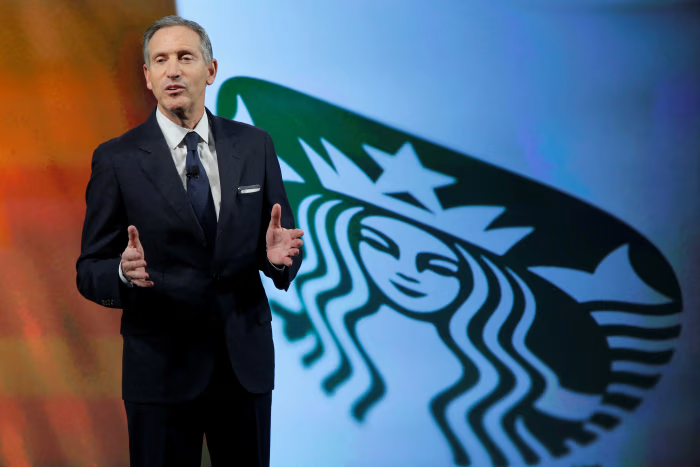
For decades, Starbucks defined the American third place in the corporate imagination. CEO Howard Schultz famously built the brand’s expansion strategy around Oldenburg’s concept, describing the Starbucks experience in a 1995 annual report as offering not just coffee, but “great people, first-rate music, a comfortable and upbeat meeting place.”
The third place was not just a branding concept for Starbucks — it was the entire thesis.
But somewhere between the advent of mobile ordering, the pivot toward drive-throughs, and the optimization of every friction point in the customer journey, something important was lost. The lobby emptied. The couches disappeared. The barista became a “drink assembler” rather than a craft professional.
By late 2024, Starbucks was posting same-store sales declines and hemorrhaging traffic to a new breed of drive-through only chains like 7 Brew and Dutch Bros, which had reimagined the third place not as a gathering space, but as the commuter’s car.
Somehow, 7 Brew’s CMO Nick Chavez was brazen about the realignment: “The ‘third place’ between home and work is your car.”
That framing tells you everything about the philosophical distance now separating fast-casual coffee from genuine community. When the living room becomes a drive-through window, something essential to the human experience has been traded away for throughput.
Starbucks’ new CEO, Brian Niccol, launched his “Back to Starbucks” initiative in late 2024, attempting to reclaim the third-place identity through physical remodels, cozy lighting, the return of comfortable seating, and baristas with Sharpies writing personal messages on cups — rituals found to be “essential” to the sense of human connection.
By 2026, Starbucks had elevated baristas to “Coffeehouse Coaches” and prototyped smaller 32-seat models at 30% lower construction cost, specifically designed to encourage what the company calls the “stay-and-sip culture.”
The scramble to recover what was lost speaks volumes about its original value.
“Independent coffee shops across the country have never stopped serving as essential community hubs. They remain safe havens for marginalized groups and crucial gathering spaces in an increasingly divided world.”
Meanwhile, independent specialty coffee shops — many of which never abandoned their community roots — are quietly thriving.
Shops like Muslims of the World Coffee & Pastries in Indianapolis, which started as a gathering space for a specific community and rapidly expanded to resonance across demographics, exemplify the irreplaceable power of purpose-driven hospitality.
When independent café operators host open mic nights, fundraise for neighbors in need, or simply memorize your usual order, they are doing something that no algorithm or mobile app can replicate: they are making you feel known.
The Market Opportunity — A Perfect Moment to Build
Paradoxically, this cultural hunger for authentic third places arrives alongside a moment of significant market opportunity. The global specialty coffee market was valued at approximately $111.5 billion in 2025 and is projected to grow to $305 billion by 2035 — a compound annual growth rate of 10.6%.
In the United States specifically, the market is expected to reach $150.88 billion by 2034, driven by premiumization, third-wave adoption, and the resilient demand of a new generation of coffee consumers who treat the café as a lifestyle destination.
Third-wave coffee, once a niche counterculture, has gone decidedly mainstream. As of 2024, nearly 45% of Americans consumed specialty coffee on any given day, up from just 25% a decade earlier.
Among the 25-to-39 age group — arguably the most influential cohort for brand-building — 64% drank specialty coffee in the past week in 2025. These are consumers who value “transparency around origin, processing method, and roaster relationships with farmers” and who willingly pay premium prices when the value proposition is built on craft and story.
That last phrase is critically important: craft and story. In a market crowded with competent coffee, quality alone is no longer a differentiator.
The independent roasters and café operators who are thriving in 2025 are doing so not because their espresso is slightly better, but because their narrative is compelling — because people feel something when they walk through the door.
The 50-State Vision — Why Scale is the Story
Most coffee brands with aspirations of national presence treat geographic expansion as a logistics exercise: find high-traffic locations, standardize the build-out, optimize the unit economics, repeat.
CoffeNZO’s 50-state ambition is a fundamentally different kind of project — and the difference is philosophical before it is operational.
“America does not need another coffee chain. What America needs — and what the social data screams out for — is a network of genuinely welcoming, community-rooted spaces that feel equally at home in a Mississippi Delta town and a Seattle neighborhood, in a Miami beach corridor and a North Dakota winter city.”
A CoffeNZO in all 50 states is, at its deepest level, a statement about belonging: that no matter where you are in America, there is a place for you.
This is not romantic marketing language. It is a direct response to a documented social crisis. When Harvard’s Making Caring Common project found that 75% of U.S. adults want “more activities or fun community events” and “public spaces that are more accessible and connection-focused,” they were describing, with precision, the gap that a purpose-built coffeehouse network could fill.
Localization is the Strategy
Winning the third-place war at a national scale requires resisting the impulse to homogenize. The most beloved third places succeed because they reflect the particular character of their communities.
The design language, the local partnerships, the specific cultural programming — these should vary by state, by city, even by neighborhood. The CoffeNZO brand identity should be the constant; the community DNA should flex.
This principle extends to products.
A CoffeNZO in Vermont might showcase local maple honey alongside the farm honey. A Texas location might lean into pecan and wildflower honey profiles.
A Pacific Northwest shop could highlight collaborations with regional micro-roasters. The specialty coffee consumer values “origin, processing method, and roaster relationships” — and that same instinct for provenance and story can be activated at the local level in every market we enter.
Suggested reads:
- How to Brew Specialty Coffee at Home
- The Right Way to Make Bulletproof Coffee
- Benefits of Adding Coconut Oil to Coffee and How to Do it Right
- How to Bloom Coffee for Pour-Over, French Press, and Drip Brewing
The Branded Product Bridge
A physical presence in all 50 states also creates an extraordinary platform for the CoffeNZO product line — bagged coffees, honey, and branded merchandise — to achieve national retail distribution with the rarest of advantages: a story customers have already experienced in person.
The café becomes the gateway to the pantry. The customer who has a transcendent Saturday morning at their local CoffeNZO becomes the customer who reaches for our cold brew at the supermarket on a Tuesday.
This integrated model — physical hospitality fueling product loyalty fueling retail expansion — is the playbook that the most enduring consumer brands have always used. What makes CoffeNZO’s version of it distinctive is the farm-to-cup authenticity and the honest community mission at the center.
What it Means to Win the Third-Place War
At its most fundamental, winning the third-place war is not a competitive exercise. It is a human one. It means recognizing that coffee shops have always been something more than places to buy drinks — they have been, across centuries and cultures, the sites where ideas cross-pollinate, where strangers become neighbors, where loneliness is interrupted by a familiar face and a warm cup.
The brands, both large and small, that are thriving in 2025 and beyond will be those that lean fully into this truth. Starbucks is spending hundreds of millions of dollars attempting to recover a sense of community that was once simply baked into the experience.
Independent operators who never abandoned that spirit are demonstrating that loyalty, in coffee, is not bought by loyalty programs — it is earned by making someone feel, every single visit, that they matter.
CoffeNZO’s advantage is that we are building from scratch, with this understanding already at the foundation. We are not retrofitting the community into a system designed for throughput. We are designing the community into the architecture from day one — into the training of every barista, the layout of every shop, the story told on every honey jar and coffee bag, and the ambition to be present in every American state.
“The best third places — whether branded or independent — are those that prioritize connection over consumption, fostering a sense of belonging that goes beyond the bottom line.”
To be America’s living room is not a metaphor we use lightly. A living room is where you are yourself. Where you are welcomed, not merely transacted. Where the morning is unhurried and the afternoon invites conversation.
Where a jar of honey on the counter is not just a product — it is a reminder that nature, craft, and care have conspired to make something beautiful for you.
That is what we are building. One state at a time.
Frequently Asked Questions
Q: What exactly is a “third place,” and why does it matter to coffee culture?
A: A “third place” is a term coined by sociologist Ray Oldenburg in his 1989 book The Great Good Place to describe informal social spaces that are neither home (the first place) nor work (the second). Coffeehouses, bars, barber shops, and parks are classic examples. Oldenburg argued that these spaces are essential to community health and democracy because they offer inclusive, low-cost environments where people from all walks of life can gather, converse, and form social bonds. In the context of modern coffee culture, the third place concept has become a central battleground: brands like Starbucks built their entire identities around it, while drive-through-only competitors have largely abandoned it in favor of speed. As America faces a documented loneliness epidemic, the value of genuine third places has never been more urgent.
Q: How is Gen Z changing the coffee industry — and what does that mean for coffee brands?
A: Gen Z is reshaping coffee in several profound ways. They began drinking coffee at a younger average age than prior generations, they overwhelmingly prefer cold coffee formats, and they treat beverage customization as a form of self-expression. Data shows that 75% of young coffee drinkers now customize their drinks, while 65% prefer beverages with functional benefits like adaptogens or protein boosts. Gen Z is also driving the “little treat culture” trend, where highly customized, aesthetically appealing coffee drinks serve as accessible daily rituals of self-care. For coffee brands, this means that the traditional emphasis on bean quality and brewing precision must be complemented by experiential storytelling, visual appeal, social media engagement, and genuine community building. Brands that only appeal to purists risk alienating the largest and most influential emerging consumer cohort.
Q: Why does CoffeNZO want to have a presence in all 50 U.S. states?
A: The 50-state vision is not simply an expansion strategy — it is a mission statement. At its core, CoffeNZO believes that everyone in America, regardless of geography, deserves access to a genuinely welcoming community coffee space. With the U.S. experiencing a documented decline in third places — the proportion of Americans regularly visiting public social spaces fell from about two-thirds in 2019 to roughly half in 2025 — there is both a cultural need and a market opportunity for a brand that builds with community at the center. A 50-state physical presence also creates a uniquely powerful platform for CoffeNZO’s branded product line, including its farm-sourced bee honey, transforming in-café experiences into lasting consumer relationships that extend into retail.
Q: What makes CoffeNZO different from other specialty coffee brands?
A: CoffeNZO occupies a rare dual-product position: artisan coffee rooted in sourcing craft and transparency, combined with farm-origin bee honey from our own farm. This combination creates an origin story that no chain competitor can authentically replicate. Our honey is not an add-on; it is proof of our supply-chain philosophy — that the relationship between nature, farmer, and cup is worthy of respect and celebration. Beyond product, CoffeNZO’s differentiation lies in a founding mission to build genuine community spaces rather than high-volume transactional environments. Every design, staffing, and programming decision is made in service of the question: does this make our guests feel more at home?
Q: How does the loneliness epidemic connect to coffee shop culture?
A: Research from 2024 and 2025 paints an alarming picture of social disconnection in the United States. The U.S. Surgeon General has declared loneliness a public health epidemic, noting that chronic loneliness carries health risks comparable to smoking 15 cigarettes a day. More than six in ten U.S. adults in 2025 reported that societal division was a major source of stress, and over half felt isolated or lacking companionship. At the same time, Americans are visiting third places — coffee shops, parks, restaurants — at significantly lower rates than before 2019. Coffee shops are uniquely positioned to address this crisis precisely because they offer the combination of accessibility, affordability, warmth, and social possibility that expensive venues or intimidating civic institutions cannot. When a barista remembers your order, when a table is always available on a rainy afternoon, when the music and the light and the smell of fresh coffee create a sense of welcome — these are not trivial amenities. They are, for many people, the moments that make a week feel bearable and a community feel real.
References
1. Oldenburg, R. (1989). The Great Good Place: Cafés, Coffee Shops, Bookstores, Bars, Hair Salons, and Other Hangouts at the Heart of a Community. Paragon House.
2. American Psychological Association. (2025, November 6). APA Poll Reveals a Nation Suffering from Stress of Societal Division, Loneliness. APA Press Release. https://www.apa.org/news/press/releases/2025/11/nation-suffering-division-loneliness
3. Fortune / Survey Center on American Life. (2025, December 18). 25 Years After Bowling Alone: Loneliness Statistics. Fortune. https://fortune.com/2025/12/18/loneliness-epidemic-bowling-alone-25-years-later/
4. Fresh Cup Magazine. (2025, March 28). Behind the Headlines: Starbucks Popularized the Term ‘Third Place,’ But What Does It Mean in 2025? https://freshcup.com/behind-the-headlines-starbucks-popularized-the-term-third-place-but-what-does-it-mean-in-2025/
5. National Restaurant News / Fantozzi, J. (2025, August 14). Is a Third-Place Coffee Shop Still Relevant in 2025? Nation’s Restaurant News. https://www.nrn.com/quick-service/is-a-third-place-coffee-shop-still-relevant-in-2025-
6. Perfect Daily Grind. (2025, December 23). Gen Z Is Reshaping Coffee, But Brands Can’t Risk Losing Loyal Customers. https://perfectdailygrind.com/2025/12/gen-z-reshaping-coffee-brand-customers/
7. Coffee Intelligence. (2025, January 30). How Gen Z Is Making Customised Coffee Cool. https://intelligence.coffee/2025/01/gen-z-is-making-customised-coffee-cool/
8. Euromonitor International. (2025). Gen Z Transforms Coffee and Tea Culture with New Preferences. Euromonitor Lifestyles Survey, January–February 2025. https://www.euromonitor.com/article/gen-z-redefines-coffee-and-tea-culture
9. Mordor Intelligence. (2026, January). US Coffee Market Size, Share & Trends Analysis 2026–2031. https://www.mordorintelligence.com/industry-reports/united-states-coffee-market
10. Fact.MR / Global Growth Insights. (2025). Specialty Coffee Market — Value (2025): USD 111.5 Billion; Forecast (2035): USD 305 Billion. https://www.factmr.com/report/specialty-coffee-market
11. Weissbourd, R., Batanova, M., & McIntyre, J. (2024). Loneliness in America. Harvard Graduate School of Education, Making Caring Common Project. https://mcc.gse.harvard.edu/reports/loneliness-in-america-2024
12. Murthy, V. (2023). Our Epidemic of Loneliness and Isolation. U.S. Surgeon General Advisory. https://www.hhs.gov/sites/default/files/surgeon-general-social-connection-advisory.pdf
13. 27gen.com. (2024, December 16). When Commerce Meets Community: The Transformation of Third Places. https://27gen.com/2024/12/16/when-commerce-meets-community-the-transformation-of-third-places/
14. Wikipedia. (2025). Third Place. https://en.wikipedia.org/wiki/Third_place
15. Anthropop / Lewis, D. (2025, June 12). Coffee Shops, Third Places and Social Design. https://anthropop.substack.com/p/coffee-shops-third-places-and-social
Related posts:
What is Specialty Coffee? Know Why It's the World's Premium Coffee
Saturday February 14, 2026How to Brew Coffee Without a Coffee Maker: 4 Methods to Make Coffee Anywhere
Sunday January 18, 2026Macchiato vs Cortado: Which Bold Little Espresso Drink Actually Wins?
Tuesday March 17, 2026Organic vs Non Organic Coffee: Similarities and Striking Differences
Wednesday January 28, 2026How to Brew Specialty Coffee at Home: Your Complete Guide
Saturday February 14, 2026Hario V60 Dripper Filters: What They Are and How to Use Them Properly
Saturday March 21, 2026Organic Cold Brew Coffee: Why It's Better and How to Make It at Home
Saturday June 27, 2026The Best Pour Over Coffee Maker with Genuine Customer Reviews
Monday February 9, 2026How to Remove Old Coffee Stains from Carpet: A Step-by-Step Guide That Actually Works
Wednesday April 29, 2026
Hi,
I’m Wycléf NY, a certified barista with 6 years of experience (as of December 2025).
I started this website to share my coffee preparation insights with aspiring coffee enthusiasts and interact with fellow baristas.
Let’s catch up over a cup of iced Coffénzo coffee or shoot me a quick short message text (sms) at ny@coffenzo.com