

The American coffee industry has never been more exciting — or more unforgiving. With over 145,000 coffee shops and hundreds of roasters operating across the United States and a market valued at a staggering $75.5 billion in 2026, the stakes are higher than ever.
Yet behind every frothy latte and artisan pour-over lies a brutally competitive business environment where only the most prepared survive. The challenges facing US coffee shop owners today are real, multi-layered, and demand more strategic thinking than at any point in the industry’s history.
Whether you are a seasoned café operator or a first-time entrepreneur with a dream, ignoring these pressures is not an option.
This blog breaks down the five most critical pressure points reshaping the industry in 2026 — from record-breaking bean prices to a raging war for digital loyalty — and what every owner must know to stay ahead.
What Every Coffee Entrepreneur Needs to Know Right Now
The challenges facing US coffee shop owners in 2026 did not appear overnight. They are the compounded result of climate shocks, post-pandemic economic shifts, rapid digital transformation, and an intensifying battle for consumer attention.
Understanding these forces — not just at the surface level but in their full operational depth — is the difference between a business that scales and one that quietly closes its doors.
The five challenges below represent the areas where the most damage is being done and, equally, where the greatest opportunities lie for owners who respond with clarity and intent.
5 Major Challenges Facing US Coffee Shop Owners in 2026
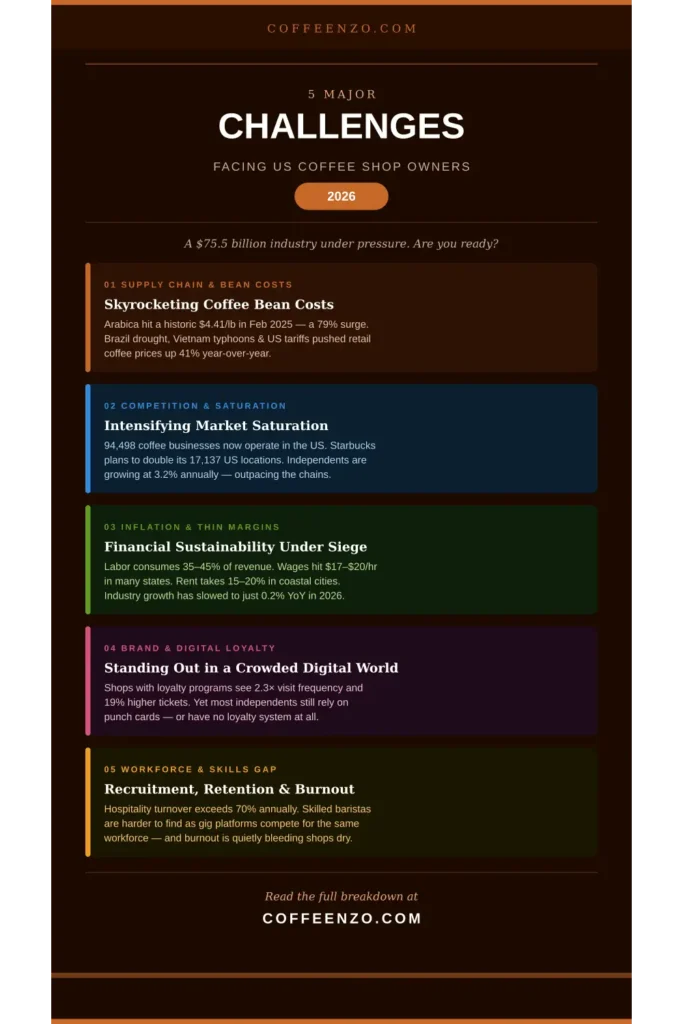
The challenges facing US coffee shop owners span every corner of the business — from sourcing and supply chains to hiring, margins, marketing, and team-building.
Each of the five challenges below is explained in full, with the data, context, and practical implications that every café owner, aspiring entrepreneur, and coffee industry professional needs to understand going into 2026 and beyond.
Challenge 1: Skyrocketing Coffee Bean Costs and Supply Chain Volatility
Of all the pressures on the industry, none is more immediate and painful than the relentless surge in coffee bean prices.
In February 2025, Arabica coffee futures reached a historic high of $4.41 per pound on the Intercontinental Exchange — a staggering 79% increase over the previous year.
While futures have eased somewhat into early 2026 as Brazilian output is expected to rebound to a record 66.2 million bags on improved weather conditions, prices remain structurally far above pre-2023 norms.
The World Bank projects Arabica will average $7.25 per kilogram in 2026, compared to just $2.93 a decade ago. For a coffee shop owner purchasing dozens of pounds of beans every week, this is not a footnote — it is an existential threat to profitability.
The price crisis is not a simple market blip. It is the product of a perfect storm converging simultaneously.
Brazil, which accounts for approximately 38% of total global coffee production, suffered its worst drought in recorded history in 2024, slashing arabica crop estimates by nearly 5%. Vietnam — the world’s largest Robusta producer — faced typhoon-related disruptions that tightened global inventories further.
Compounding the agricultural shock, Washington imposed a 50% tariff on Brazilian beans in July 2025, causing ICE-monitored arabica stocks to plummet to a 1.75-year low of approximately 431,481 bags.
Importers scrambled to reroute cargoes and paid cancellation fees of $20–$25 per bag, while US retail coffee prices rose 41% year-over-year according to the Bureau of Labor Statistics.
A typical supermarket blend climbed from $6–$7 to $11 per pack — and café menus absorbed similar pressure.
Forward-thinking operators are responding by diversifying bean sourcing across multiple origins — Colombia, Ethiopia, and Mexico — to reduce dependency on any single country.
Others are exploring in-house roasting to shield against wholesale markups, with some cutting coffee input costs by up to 50% by sourcing green beans directly.
Locking in forward contracts with trusted importers, even at slightly elevated prices, is also proving a smarter long-term play than chasing the volatile spot market. Supply chain resilience is no longer optional; it is a survival strategy.
Compare: Coffee Shop Labor Shortage
Challenge 2: Intensifying Competition and Market Saturation
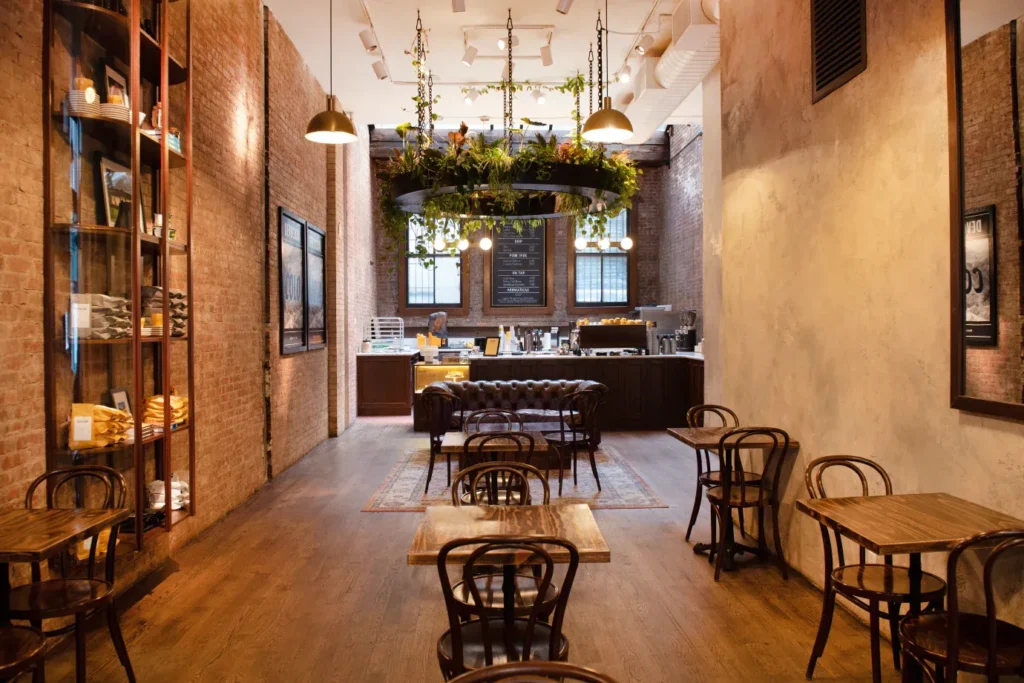
The US coffee shop market has never been more crowded. According to IBISWorld’s 2026 industry analysis, there are now 94,498 coffee and snack shop businesses operating across the country — a compound annual growth rate of 5.8% since 2021.
On the chain side, Starbucks alone operates 17,137 US locations and has publicly committed to doubling its domestic footprint to 34,000 stores.
Dunkin’ holds strong with nearly 10,000 locations, while Dutch Bros, Black Rock Coffee, and a wave of other aggressive regional chains are muscling into suburban and secondary markets that were once safe territory for independents.
Fast-food giants like McDonald’s and convenience chains like Wawa and Sheetz have dramatically upgraded their coffee programs, competing directly for the morning traffic that independent shops depend on most.
Interestingly, the competitive picture is more nuanced than chains simply crushing independents.
Data from the Joe network — which tracks over 64,000 independent coffee shops — shows that independents are actually growing at 3.2% annually, outpacing Starbucks’ domestic same-store growth.
The average ticket at independent shops rose to $8.47 in 2026, up from $7.82 the previous year. Even Starbucks reported a 6% dip in same-store sales for Q4 fiscal year 2024, underlining that scale alone does not guarantee loyalty.
Younger consumers, particularly Millennials and Gen Z, are actively seeking local, authentic experiences that chains cannot replicate — and that creates real opportunity for operators who understand what they are competing on.
Independent operators who are thriving in this saturated environment have identified a specific niche and defended it ferociously.
Whether that is hyper-local sourcing, a genuine neighborhood “third place” community model, specialized brewing methods, or bold menu innovation with global flavors and functional ingredients, the winners give customers a reason to choose them that no corporate brand can copy.
Saturation does not mean the end of opportunity — it means the end of mediocrity.
Challenge 3: Inflation, Thin Margins, and Financial Sustainability
Even in the best of times, running a coffee shop is a low-margin business. Labor, rent, utilities, supplies, and equipment combine to consume the vast majority of revenue before the owner sees a cent of profit.
In 2026, IBISWorld projects that rising operational costs will eat into profitability across the industry even as overall revenue edges upward.
The industry’s overall growth rate has slowed to a tepid 0.2% year-over-year, signaling a meaningful deceleration in expansion momentum. For owners operating on already-thin margins, this environment leaves almost no room for error.
Labor is the single largest controllable expense for most coffee shops, typically representing 35% to 45% of revenue.
The national push for higher minimum wages — with several states now mandating $17–$20 per hour — has dramatically raised the baseline cost of staffing even a single location. Beyond wages, constant training costs mount as turnover remains a chronic industry problem.
At the same time, commercial real estate costs in desirable urban and suburban markets have remained stubbornly elevated post-pandemic; in coastal cities, rent alone can consume 15–20% of gross revenue.
When bean costs surge, wages rise, and rent stays high simultaneously, the financial model for an average coffee shop becomes extremely fragile.
The most financially resilient operators in 2026 are those treating their business with the rigor of a manufacturing company. They implement detailed recipe costing, monitor controllable costs weekly, and use modern POS-integrated inventory systems to eliminate waste.
Many are diversifying their revenue streams by adding retail product lines — packaged beans, branded merchandise, or specialty food items — to reduce dependence on over-the-counter beverage sales.
Subscription coffee programs, which lock in recurring revenue from loyal customers, are also gaining traction as a way to smooth cash flow across traditionally volatile periods. Financial discipline is not glamorous, but in 2026, it is the foundation of every successful café.
Challenge 4: Brand Differentiation and Customer Loyalty in a Crowded Digital World
A decade ago, a beautiful café with great coffee practically marketed itself through word of mouth. Today, that is simply not enough. Every coffee shop — from the indie micro-roaster to the corporate chain — is competing for the same Instagram feeds, TikTok moments, and Google Maps searches.
This digital noise is deafening, and standing out demands both creativity and consistency that many small operators struggle to sustain.
The challenges facing US coffee shop owners in the digital space are compounded by the fact that consumer expectations around personalization, speed, and brand storytelling have risen dramatically — and chains with massive technology budgets are setting the standard.
Data from the Joe network makes a compelling case for formal loyalty infrastructure: coffee shops with active loyalty programs see 2.3 times the visit frequency and 19% higher average tickets compared to those without.
Despite this, a significant proportion of independent shops still rely on paper punch cards or have no loyalty program whatsoever.
Meanwhile, Starbucks continues to refine one of the most sophisticated loyalty ecosystems in all of retail, with its app driving a disproportionate share of its total sales.
For independent operators, competing requires investment in affordable digital loyalty platforms capable of personalized offers, birthday rewards, and behavioral triggers that keep customers engaged between visits.
The coffee brands winning the loyalty battle in 2026 are those that have built identities extending well beyond the product. They have a clear story — about sourcing, sustainability, community, or craftsmanship — that gives customers something to believe in and share.
User-generated content, local partnerships, and seasonal limited-edition offerings create organic digital moments that no advertising budget can fully replicate.
For shop owners eyeing expansion, consistent brand presentation across physical and digital touchpoints is the foundation on which multi-location growth is built.
Customers must recognize your brand and feel connected to it, whether they encounter it in a storefront, on social media, or on a retail shelf.
Challenge 5: Workforce Recruitment, Retention, and the Skills Gap
A coffee shop is only as good as the people behind its counter, and right now, finding, training, and keeping skilled baristas and front-of-house staff is one of the most pressing operational problems in the industry.
The food service and hospitality sector routinely sees annual turnover rates exceeding 70%, and coffee shops are not immune.
Every time a trained barista walks out the door, an owner absorbs the cost of recruiting, onboarding, and retraining a replacement — alongside the service inconsistency that erodes the customer experience during every transition. It is a cycle that silently bleeds both cash and reputation.
Several structural forces are converging to make staffing harder than it has ever been. Competition for workers has intensified across all sectors of the service economy, with delivery platforms, retail chains, and gig economy opportunities offering flexible scheduling that traditional café shifts cannot match.
Meanwhile, the technical skill ceiling for specialty coffee is rising sharply — consumers have become increasingly sophisticated in their expectations around espresso extraction, latte art, and alternative brewing methods.
Training a barista to consistently produce high-quality specialty drinks now takes months of deliberate practice and structured oversight, a significant investment that evaporates the moment that employee leaves for a higher wage elsewhere.
Burnout driven by physical demands and the emotional labor of customer-facing work compounds the problem further.
The most successful operators in 2026 are approaching staffing with the same strategic intentionality they bring to menu development and marketing. They are creating structured onboarding and training programs that build competence and confidence from day one.
They are offering transparent career pathways — from barista to shift lead to assistant manager and beyond — so team members see a future, not just a job.
Performance recognition, competitive wages, and a genuinely supportive workplace culture are emerging as more powerful retention tools than any single intervention alone.
A stable, motivated, and skilled team is one of the most durable competitive advantages any coffee shop can possess — and it is one that no chain can easily replicate in a small-scale, community-rooted operation.
Conclusion: Pressure Creates Diamonds
What have we learnt so far?
The five main challenges facing US coffee shop owners are skyrocketing coffee bean costs, intensifying competition and market saturation, inflation, customer loyalty in a crowded digital landscape, and the recruitment and retention of the coffee shop workforce.
But the coffee shop industry — with its $75.5 billion market size, over 145,000 locations, and deeply embedded role in American daily life — is not collapsing. It is evolving.
The shops that are thriving in this environment are doing so not by accident but by making deliberate, data-driven decisions about sourcing, pricing, staffing, marketing, and customer experience at every level of their operation.
For entrepreneurs building brands with vision, a unique product story, and the ambition to grow — brands rooted in authenticity, community, and craft — the current climate, while demanding, also presents genuine and meaningful opportunity.
As chain brands grapple with same-store sales declines and consumers increasingly gravitate toward independent experiences that feel real and personal, the operator who masters the fundamentals has never had a stronger case to make.
The market does not reward average. It rewards those who prepare, adapt, and lead. The question for every coffee shop owner in 2026 is a simple one: which side of that divide will you be on?
Frequently Asked Questions
The following questions are among the most common raised by coffee shop owners, aspiring entrepreneurs, and industry observers as they navigate the realities of 2026. The answers draw directly from the data and analysis covered throughout this blog.
Q: What is the biggest financial challenge for US coffee shop owners in 2026?
A: Rising coffee bean costs are arguably the most acute financial challenge in 2026. Arabica futures hit a historic high of $4.41 per pound in February 2025 and, while prices have moderated somewhat, remain structurally higher than pre-2023 baselines. Combined with higher labor costs and elevated commercial rents, the input cost squeeze is compressing margins across the industry. Operators who diversify sourcing origins, lock in forward contracts, and explore in-house roasting are best positioned to manage this sustained pressure.
Q: How competitive is the US coffee shop market in 2026?
A: Extremely competitive. IBISWorld counts 94,498 coffee and snack shop businesses in the US as of 2026, and the market has grown at a CAGR of 5.8% since 2021. Major chains like Starbucks and Dunkin’ dominate at the national scale, while fast-food chains and convenience stores have dramatically upgraded their coffee offerings to compete for morning traffic. That said, independent shops are growing at 3.2% annually and winning with younger, discerning consumers on quality, authenticity, and local connection.
Q: Why is staff retention such a persistent problem for coffee shops?
A: The food and hospitality sector routinely experiences annual turnover rates exceeding 70%, and coffee shops face the same structural pressures. Competition from the gig economy and flexible retail jobs makes it difficult to retain workers on fixed café schedules. The physical and emotional demands of barista work contribute to burnout, while the specialist skills required for specialty coffee represent a significant training investment that is lost every time an employee departs. Operators who build genuine career pathways and invest meaningfully in workplace culture consistently report better retention outcomes.
Q: How important are digital loyalty programs for coffee shops today?
A: Critically important. Industry data shows that coffee shops with active digital loyalty programs see 2.3 times the visit frequency and 19% higher average ticket sizes compared to shops without them. In a market where customers have abundant choice, loyalty infrastructure is one of the most powerful tools available for building recurring revenue and emotional brand connection. Paper punch cards are no longer sufficient — modern coffee businesses need digital platforms capable of personalized engagement and behavioral marketing.
Q: Can independent coffee shops realistically compete with major chains in 2026?
A: Yes — and the data firmly supports this. Independent coffee shops are outgrowing Starbucks domestically, with independents at 3.2% annual growth while the chain giant reported declining same-store sales. Younger consumers are actively choosing local, authentic experiences over corporate uniformity. Independents win by building genuine community connections, curating distinct brand identities, sourcing ethically, and delivering craft-quality experiences that no chain can replicate at scale. The key is executing the fundamentals — sourcing, staffing, marketing, and financial management — with precision and real intention.
References
IBISWorld (January 2026). Coffee & Snack Shops in the US Industry Analysis 2026. https://www.ibisworld.com/united-states/industry/coffee-snack-shops/1973/
IBISWorld (March 2026). Coffee Production in the US Industry Analysis 2026. https://www.ibisworld.com/united-states/industry/coffee-production/272/
Joe Coffee Network (February 2026). Coffee Industry Trends 2026: Data from 64,000+ Independent Coffee Shops. https://joe.coffee/coffee-industry-trends/
Toast (March 2026). Top Coffee Shop Industry Trends and Statistics in 2026. https://pos.toasttab.com/blog/on-the-line/coffee-shop-industry-trends-and-statistics
LocationsCloud (April 2026). Coffee Shop Industry Statistics US: A Complete Statistical Breakdown. https://www.locationscloud.com/research-report/us-coffee-shop-industry-statistics-guide/
Perfect Daily Grind (February 2026). Last year was difficult for the coffee industry: Will 2026 be different? https://perfectdailygrind.com/2026/02/will-2026-be-different-coffee-industry-challenges/
Bellwether Coffee (February 2025). The Great Coffee Price Surge: What This Means for the Industry. https://bellwethercoffee.com/blog/the-great-coffee-price-surge-what-this-means-for-the-industry
Food Business News (February 2025). Coffee Prices at Record Highs Amid Tight Global Supplies. https://www.foodbusinessnews.net/articles/27682-coffee-prices-at-record-highs-amid-tight-global-supplies
Deriv (November 2025). Coffee Prices Surge as Brazil Drought Deepens. https://deriv.com/blog/posts/coffee-price-forecast-us-brazil-trade-talks
Mordor Intelligence (February 2026). US Coffee Market Size, Share & Trends Analysis 2026–2031. https://www.mordorintelligence.com/industry-reports/united-states-coffee-market
Pro Coffee Gear (2026). Coffee Shop Trends and Industry Insights 2026. https://procoffeegear.com/blogs/articles/coffee-shop-trends-insights
World Bank / Statista (April 2025). Average Prices for Arabica and Robusta Coffee Worldwide 2014–2026. https://www.statista.com/statistics/675807/average-prices-arabica-and-robusta-coffee-worldwide/
IMARC Group (2026). US Coffee Market Size, Share, Trends & Forecast to 2034. https://www.imarcgroup.com/us-coffee-market
Bean & Brew Tech (November 2025). Coffee Shop Challenges 2026: What Owners Need to Know to Succeed. https://beanandbrewtech.com/coffee-shop-challenges-2026-what-owners-need-to-know-to-succeed/

Hi,
I’m Wycléf NY, a certified barista with 6 years of experience (as of December 2025).
I started this website to share my coffee preparation insights with aspiring coffee enthusiasts and interact with fellow baristas.
Let’s catch up over a cup of iced Coffénzo coffee or shoot me a quick short message text (sms) at ny@coffenzo.com